Best Time to Visit the Rome Catacombs
Most Roman sights reward an early start because of queues. The catacombs reward one for a different reason: the sessions are short, the closures are staggered, and the middle of the day does not exist. Timing this visit well is mostly about the calendar, not the clock.
The best time of day
Morning, and not marginally. The sites open at 09:00 or 09:30 and the last morning visit leaves at noon, which gives you three hours of departures. Then everything closes until 14:00.
The afternoon session runs to 17:00, but the final descent is earlier than that — a visit takes about 40 minutes, so the last group at San Callisto goes down around 16:20, and Domitilla starts its last visit 20 minutes before closing. Turning up at 16:45 means a locked gate.
| Site | Morning | Afternoon | Last descent |
|---|---|---|---|
| San Callisto | 09:00–12:00 | 14:00–17:00 | ~16:20 |
| Domitilla | 09:00–12:00 | 14:00–17:00 | 20 min before close |
| Priscilla | 09:30–13:00 | 14:00–17:00 | 16:00 |
| Capuchin Crypt | 09:30–13:30 | 14:30–18:30 | 17:30 |
The best day of the week
Thursday to Sunday, when San Callisto, Domitilla and Priscilla are all open and you can choose on merit rather than availability. Monday, Tuesday and Wednesday each remove one site from the board.
- Monday: Priscilla closed
- Tuesday: Domitilla closed
- Wednesday: San Callisto closed
- Sunday: all three open, and quieter than you would guess
Which of them you want is a separate question, answered on our comparison of the four sites.
The best time of year
Here the catacombs invert the usual advice. Summer is the peak season everywhere else in Rome and the reason to consider it here: the galleries hold 15 to 16 °C in August, and an hour underground in the middle of a heatwave is the most comfortable hour of the day.
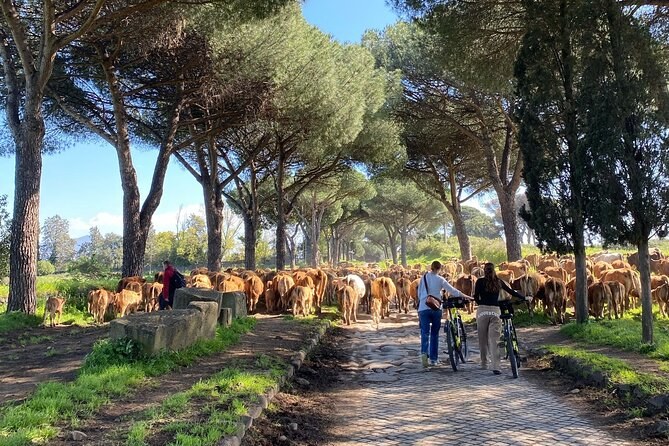
Spring and autumn are the classic choice and they are lovely, particularly if you are combining the visit with the Appian Way on foot or by bike. Winter is quiet and perfectly pleasant below ground, where the temperature never changes — but check the closures first.
The best time to book
Between April and October, several days ahead. The small-group departures cap at ten to fifteen travellers and the after-hours trips run on fewer dates than the daytime ones, so both fill. In November and February you can often book the day before.
Because nearly every departure refunds in full at 24 hours, booking early costs you nothing but the decision. If your dates are tight, an after hours Rome Catacombs tour runs on fewer evenings than the daytime trips and is the first thing to fix.
After hours: the version with nobody else in it
A handful of departures go into Priscilla in the evening, after the site has closed to everyone else. It is the same catacomb and a completely different experience — no other group ahead of you in the corridor, no waiting at the junctions. They run on limited dates and both are flagged as likely to sell out.
If the idea of a quiet catacomb is what appeals, this is how to get it. You can compare Rome Catacombs tours by departure time on one page.
Fitting it into a Roman day
A catacomb visit is a half-morning, not a day. The natural shape is: go early, be back in the centre for lunch, spend the afternoon somewhere that does not close at noon. The e-bike and golf-cart trips are the exception, running three to six hours because the Appian Way itself is the attraction.
If you want to double up, the Capuchin Crypt on Via Veneto is open all day, every day, and is the obvious pairing — which is exactly why six departures bundle the two. The reason they work so well together is on the catacombs one by one.
Season by season, honestly
Summer, June to September. The counter-intuitive winner. Rome above ground is punishing and the galleries are not, so a catacomb slot becomes the most comfortable hour of your day rather than the hardest. The trade-off is that everything books up, so reserve several days out and take a morning departure to keep the rest of the day free.
Autumn, October and November. The best all-round choice if you also want the Appian Way itself. The road is walkable and cyclable in comfort, the light is good, and the e-bike departures come into their own. Sites are quieter and same-week booking is usually fine.
Winter, December to March. Quietest of all, and underground the temperature is identical to August. The catch is the maintenance closures, which cluster in this window — San Callisto's runs about a month from mid-January. Check before you commit to a date.
Spring, April and May. Everything is open, the weather suits the walk out along the road, and the crowds have not fully arrived. The only real drawback is Easter, when the sites close on the Sunday itself and are busy either side of it.
How the season changes what to book
In high summer the argument shifts toward departures that keep you out of the sun: a coach transfer rather than a bus, an express visit rather than a long walk in the open, or the two-hour Domitilla descent, which is essentially an afternoon spent at 16 °C. In spring and autumn the opposite applies — the e-bike and golf-cart trips along the Appian Way are at their best, and the road becomes as much of the attraction as the galleries.
Winter suits the combinations that spend most of their time indoors, pairing a catacomb with the Capuchin Crypt on Via Veneto. What is in each site is set out on the catacombs one by one, and the money side is in our guide to tickets against tours.
The short version
One more thing worth folding into the plan: the sites are consecrated ground and still in use for services, so the occasional feast day changes the schedule at short notice. It is rare, and it is the sort of thing a booked departure absorbs for you while a door ticket does not.
Thursday to Sunday, first thing, in summer if you have the choice, booked a few days out, and not in the middle of January. Get that right and the rest of it — the temperature, the quiet, the sheer strangeness of a corridor of empty graves — takes care of itself.
Rome Catacombs Tours lists the departure times alongside the price and the site each one enters, and visiting the Rome Catacombs has the admission and access detail.
Tours for the season you are travelling in
Two after-hours departures for the summer weeks, and a spring or autumn ride on the old road.