What Surprises Rome Catacombs Visitors
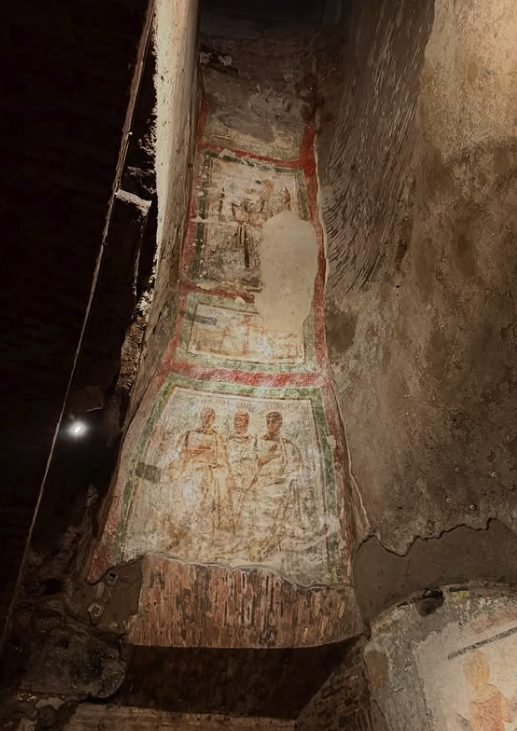
The catacombs draw a particular kind of surprise. People arrive with a picture in their head — usually assembled from films and from photographs of somewhere else entirely — and what they find is quieter, cooler and stranger than that. Here is what actually catches visitors out, in the order they notice it.
One thing that surprises nobody who has done it: the evening version is better. A Rome Catacombs night tour goes down after the site has closed to everyone else.
1. The niches are empty
This is the big one. You will walk past thousands of loculi, the rectangular graves cut into the corridor walls and stacked five high, and almost every one is bare rock. No bones, no coffins, no remains.
They were emptied on purpose. From the eighth century the popes moved relic after relic into the churches inside the walls, as the unwalled suburbs became unsafe. By the time the sites were sealed and forgotten, they had already been cleared. The full sequence is on the history of the Rome Catacombs.
2. It is cold, and that is the best thing about it
The galleries hold 15 to 16 °C all year, whatever Rome is doing above. In August, when the city is at 35 °C and the queues at the Colosseum are in full sun, going down a staircase into a cool corridor is a physical relief. It is the most-praised thing about a summer visit.
The corollary is that you want a layer, even in July. The change happens over about fifteen steps and it is abrupt.
3. The dress code is real and it is enforced
Knees and shoulders covered, men and women alike, checked at the door. These are consecrated burial grounds, the rule is not decorative, and operators say plainly that entry is refused without it. In summer that means the vest top and shorts you were wearing at the Forum will not get you in.
A scarf or a light shirt in your bag is the whole solution, and it is the layer you wanted anyway.
4. No photographs, anywhere inside
Cameras and phones stay away for the whole visit, at every site. It is partly conservation and partly crowd flow — a group of fifteen stopping to photograph a fresco in a one-metre corridor does not move. Guides enforce it.
There is an upside. Forty minutes without a viewfinder is forty minutes of looking, which is rarer than it should be in Rome. Our gallery carries the pictures.
5. No signal, for the whole time you are down there
Several storeys of volcanic rock block it completely. No calls, no data, no maps. Agree a meeting point with anyone waiting above before you descend, and have your booking downloaded rather than sitting in an email you were planning to open at the door.
6. It is narrower than you expect, and that is fine for most people
The corridors are about a metre wide with the ceiling close over your head, and the floor is worn. It is a level walk with stairs at either end — not a scramble, not a crawl. Most visitors find it perfectly manageable.
If you know that narrow spaces are difficult for you, take it seriously and choose the shortest time below ground rather than the longest. Several operators say directly that their tour is not the right one in that case. What to expect underground names the departures with the briefest descents.
7. The paintings need a guide's lamp to see
The earliest Christian art anywhere is on these walls: the Good Shepherd, orant figures with arms raised, banquet scenes, Jonah and Daniel. Much of it is faint, in earth pigments on plaster, and in the general lighting you would walk past it. It is the guide's lamp and the guide's finger that make it legible.
This is the most concrete argument for a guided departure over a door ticket, and the technique that made the galleries possible is explained on how the catacombs were dug.
8. Christians were not hiding down there
The persecution story is the most durable myth about the catacombs and it does not survive contact with the evidence. These were cemeteries, registered and well known, on land the community owned. What drew crowds underground was pilgrimage to the martyrs' tombs, not concealment.
The galleries were never secret. They were simply out of town, because the law required it.
9. The word itself comes from one site
The hollow beside the basilica of San Sebastiano was called ad catacumbas, "at the hollows". The name attached to that one cemetery, then spread until it meant every Christian burial gallery on earth. Which of the sites has which story is set out on our comparison of the four.
The nine, at a glance
| What surprises people | What to do about it |
|---|---|
| The niches are empty | Add the Capuchin Crypt if you want bones |
| 15–16 °C all year | Take a layer, even in August |
| Dress code enforced at the door | Carry a scarf or a light shirt |
| No photography inside | Leave the camera in the bag and just look |
| No phone signal | Download your booking, agree a meeting point |
| One-metre corridors | Pick a short descent if that is difficult |
| Paintings are faint | Go with a guide rather than a bare ticket |
| Nobody was hiding down there | Read it as a cemetery, not a refuge |
| The word comes from one site | San Sebastiano, if the etymology appeals |
And one thing that surprises people afterwards
How much of Rome is still down there. Roughly sixty catacombs are known beneath the city and its approaches, and only a handful are open at all. The rest are sealed for conservation, mapped but unvisited, with access limited to researchers working with the Pontifical Commission for Sacred Archaeology.
Standing in a lit corridor knowing that it runs on into the dark for kilometres, on levels above and below the one you are walking, is a different feeling from looking at a ruin. It is the one part of ancient Rome that has not been tidied up for visitors, and the questions people ask afterwards tend to be about scale rather than history.
What nobody is surprised by
Almost everyone comes out saying the same thing: it did not look like anything else in Rome. That is the point. Above ground the city is marble and crowds; forty metres down it is tufa, lamplight and silence, and you have the corridor to yourselves.
Know the nine things above and none of them can catch you out. Rome Catacombs Tours lists the departures with the site, the duration and the time you actually spend in the galleries.